A Central & Symbolic Role in Scottish History
Early History
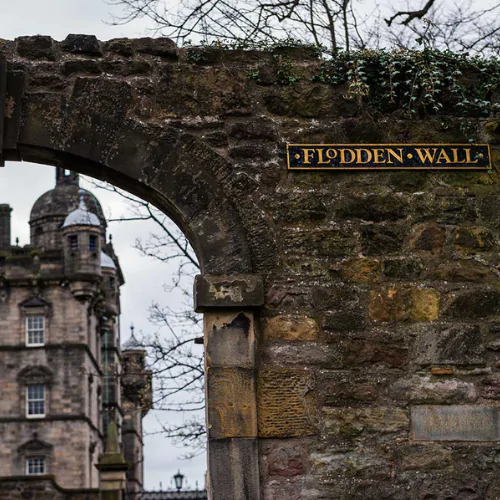
Greyfriars was built on the site of a pre-Reformation Franciscan monastery, which explains how the name of the Kirk came to be (so-called after the robes that the friars wore). However, following the Scottish Reformation of 1560, the grounds of the Franciscan monastery (which was then on the outskirts of the city) passed into the possession of Mary Queen of Scots, who subsequently granted it to the town council, for use as a burial ground, later bordered by the famous Flodden Wall.
By the end of the sixteenth century, a new church was needed for the south-west parish of the city and building work began on Greyfriars in 1602. Greyfriars was to be the first post-Reformation church built in Edinburgh – however, progress was slow, and the new church did not open until Christmas Day 1620.
Read More
The National Covenant
In 1638, the National Covenant was presented and signed in front of the pulpit. This was a document of great importance in the history of Scotland (an original copy is on displayed in our museum). This was a crucial development in a turbulent period in Scotland’s history, revolving around religious and civil freedom. For centuries, the idea of monarchs ruling by ‘divine right’ was the established norm; but reformers, though loyal to the monarch, could not accept the idea of his or her divine authority to govern. The Covenant was the resulting declaration of rights; the right of ordinary people to exercise their God-given consciences in matters of faith and life. By promoting the idea that no individual had privileged access to, or knowledge of, the divine, and by encouraging people to read the scriptures for themselves, it could be argued that the Reformation movement led eventually to the ideas of democratic rights that developed during the eighteenth-century Enlightenment.
Read More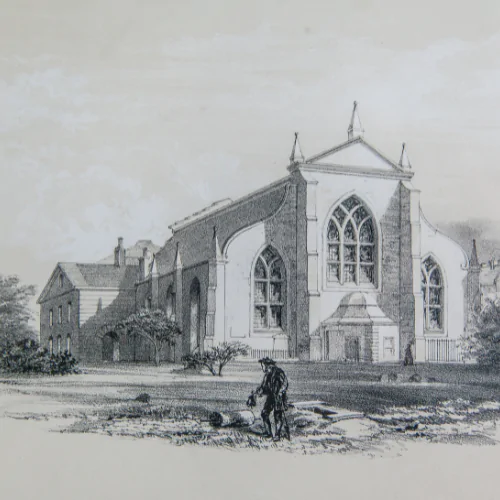
Transforming Worship
In 1845 tragedy struck – fire gutted Old Greyfriars and destroyed the furnishings of New Greyfriars. Even today, the sides of the windows in the eastern part of the church show traces of fire damage. The restoration took many years – following the fire, the original roof and arcades were removed and, a few years later, a new, single-span roof introduced. The windows were made into lancets and stained glass – the first in any Scottish parish church since the Reformation.
At the same time, a movement began towards reviving a less puritanical style of worship. Worship in the Church of Scotland was notoriously austere, with long prayers and sermons. Music for psalm-singing was limited to a few tunes, and the setting for worship nearly always lacked ornament of any kind. Rev Robert Lee, the minister at the time of the fire, saw an opportunity to reform aspects of worship and church order.
Read More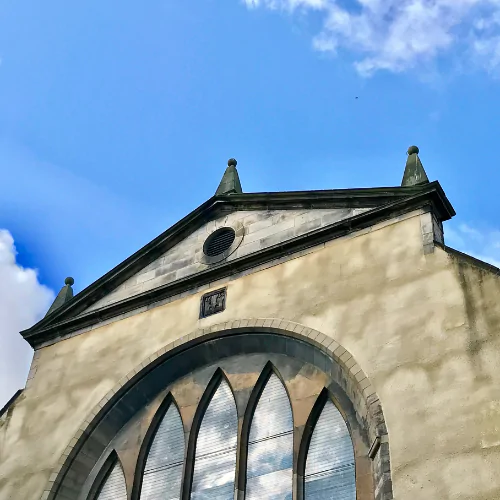
Between 1931 and 1938 (the tercentenary of the signing of the National Covenant), an ambitious programme of reconstruction followed; the two churches were united and Old and New Greyfriars became one congregation. The dividing wall between the two halves of the building was taken down, Old Greyfriars’ arcades were restored, and a ceiling of Californian redwood was built over the six bays of the original church. Much of the interior as you see it now dates from 1938. Several bosses were added to the ceiling, showing the St Andrew saltire and key dates in the kirk’s history.
At the west end of the Kirk stands the magnificent Peter Collins organ. Built in 1990 to replace a Hamilton organ sited in the north-west corner, the Collins organ contains nearly 3,400 pipes and has three manuals. The Latin motto inscribed on it comes from the last verse of Psalm 150 and translates as ‘Let everything that hath breath praise the Lord’.